
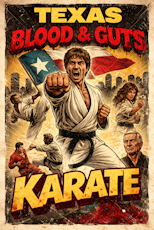
There was a time in Texas when karate wasn’t about belts, branding, or business models.
It was about proving yourself.
This was an era before the UFC and before the now widely available McDojo with magical powers and DragonBall Z Energy Balls. It was about stepping onto the mat, knowing the person across from you was trying just as hard as you were—and sometimes hitting just as hard too.
They used to call it “blood and guts karate.” And in North Texas, few places embodied that better than the Texas Karate Institute.
The Rise of Hard Karate in Texas
The roots go back to pioneers like Allen Steen, who helped bring a tougher, competition-driven version of karate to Texas. This wasn’t point-and-smile karate. This was contact, pressure, and performance.
By the late 1970s and into the 1980s, Texas had become a hotbed for serious martial artists. Dojos weren’t just schools—they were proving grounds. You didn’t just learn techniques; you tested them. Texas was unique in the fact that boxing and wrestling techniques were already being incorporated into American Karate.
And if they didn’t work… You found out quickly.
Texas Karate Institute (TKI) 
The Texas Karate Institute—part of the broader American Karate Black Belt Association—became one of the central hubs of that culture.
Under instructors like David Mason and others in the network, TKI developed a reputation for producing fighters who could handle themselves under pressure. The school was also the home of the Mason’s PittBulls Kickboxing Team which produced World Champions in the era of PKA Kickboxing.
Classes weren’t easy. Advancement wasn’t automatic. And black belt?
That was something else entirely.
Starting the Journey (Early 1980s)
I started training at TKI in the early 1980s.
Like a lot of people, I walked in not really knowing what I was getting into. But it didn’t take long to understand: this wasn’t a casual after-school activity.
This was serious.
Training meant repetition, discipline, and a steady diet of sparring. You learned your forms, your basics—but you also learned how to deal with someone trying to land a shot on you. Sometimes you got K.O.’d but it wasn’t a set back, it was a joint learning experience showing us what worked and what was just in the movies. This taught us what would be effective in real-world situations.
And you trained with the same group, over and over.
You got to know them.
You had to. They were not just other people at your gym, they became extended family.
The Room on 1974 Nantucket with the red mats, the USA Flag, and the Korean Flag.
By the late 80s, the Richardson location on Nantucket Drive had developed a core group of advanced students pushing toward black belt.
Among those in that training circle were: (Not all, but the ones I can remember)
Josh Hochshuler
Eddie Watson
Aki Ohashi
Michael Sherman
Brett Byrd
Robert Sloan
Barry Byres
Larry Wheeler
Mike Webb
Willie King
Liz Verra
James “Rabbit” Brown
This wasn’t just a class. It was a crucible. You bow on to the mat ready to work and learn.
We sparred constantly. You learned quickly who was faster, who hit harder, who had better timing—and where you stood in that hierarchy.
And if you wanted to move up, there was only one way:
Work.
Earning the Black Belt
I trained for my black belt under David Mason, and on October 19, 1990, I was promoted by Barry Guimbellot.
That date matters.
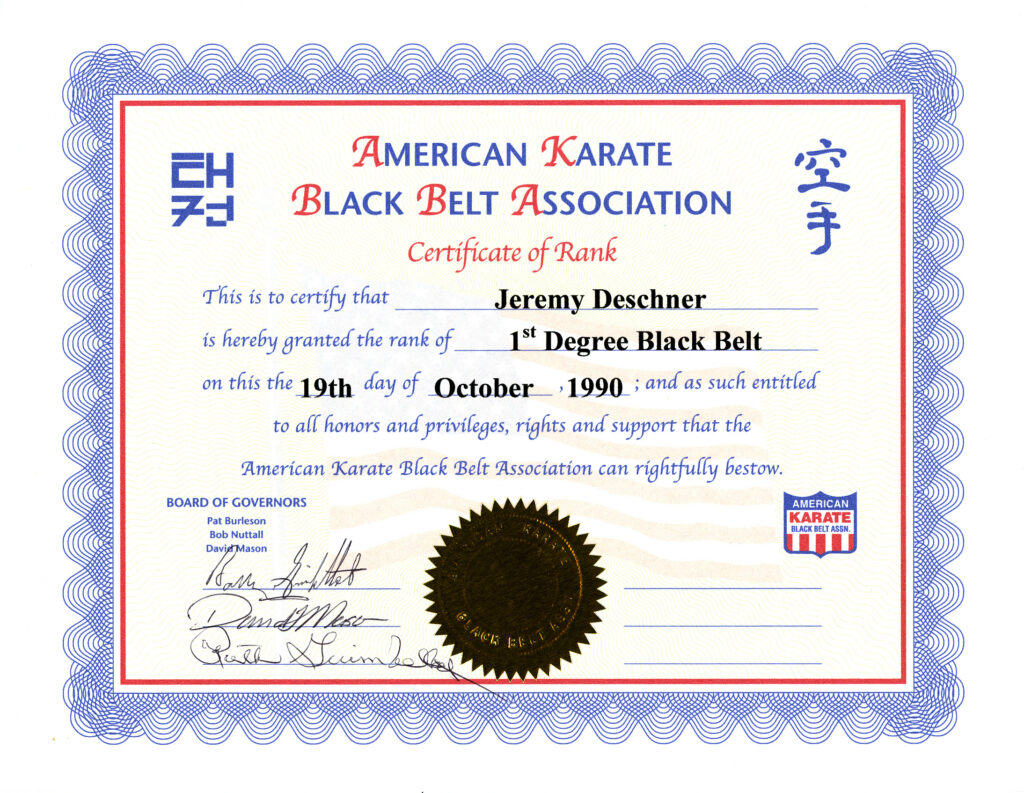
Because back then, black belts weren’t given—they were earned.
There were no shortcuts. No watered-down tests designed to pass everyone.
You were evaluated under pressure.
You sparred when you were tired.
You performed when you were exhausted.
You kept going when you wanted to stop.
You performed perfectly every Kata, every technique, every combination, broke boards, did one-step reaction drills, AND THEN you sparred for a couple of hours. No one was taking it easy on you, you earned every inch of that mat and the respect that comes with the honor of holding the rank of a TKI Black Belt. This was done in front of a board of high ranking black belts. After this test of knowledge, stamina, dicipline, and Texas heart, the board of high ranking black belts retire to the locker room and vote on if you qualified to be amongst the brotherhood of those that hold the rank of black belt in the TKI system.
And when it was over, the result meant something. Something you can hold on too for the rest of your life where ever life takes you.
Blood and Guts Karate
“Blood and guts karate” wasn’t about being reckless.
It was about honesty.
Honest technique
Honest effort
Honest results
Those black belts were built through repetition, contact, pressure—and sometimes blood and guts.
What Remains
The building may be gone. But the experience doesn’t disappear.
Everyone who trained in that room carries it with them.
The discipline.
The resilience.
The understanding of what it means to earn something.
Final Thought
It was simple.
It was hard.
And it was real.
Those black belts meant something.
And the people who earned them know exactly why.


